

Gina Mallet (1938 – 2013) was a theatre and restaurant critic whose interest in good food led her to write Last Chance to Eat. In the book she recalls her childhood living in Shillingford Court.
Although some of the dates and names vary from our records, we have decided to extract the relevant passages to show life in Shillingford from the late 1930’s through to 1950s when the family moved back to London.
When my father and mother married in the late 1930s, they celebrated their love affair by buying a folly: an imposing house that stood high on the banks of a double bend in the Thames as the river slumbered along from Oxford to Henley. The house, which was called rather grandiosely Shillingford Court after the humble hamlet around it – a straggle of thatched cottages and a farm – was an unashamed Edwardian extravagance. It had been built by one of Edward VII’s tailors. Any man who dressed the King, my father told us children, had to be enormously rich, because the King changed his clothes at least five times a day and expected those around him to do likewise. If they didn’t, they became the butt of royal sarcasm.
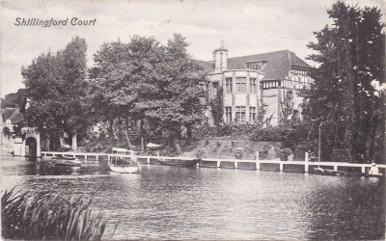
Shillingford Court 1940s
Mr Haggie*, as our tailor was called, built royally, as if summoning up past ages of glory. The court was a mishmash of styles – a tower with battlements, some half timbering, lead-paned windows, stone walls a couple of feet thick – and it was wrapped around a big, flagged terrace with wide steps that led down to the riverbank. Seen from the river, the house was screened by trees, giving it an air of Gothic mystery. The rooms were huge: the library was 30ft long and light poured in from the windows at either end. Even the halls were wide and long, upstairs and down, and lined with windows so that the walls and ceiling rippled with the reflected light of the sun, however watery, that shone on the river.
At right angles to the actual house was the largest room of all, the size of a football field and two storeys high. The river room, as we called it, stretched out over the boathouse: it had a bank of windows facing south, a range of skylights and a minstrel’s gallery approached by two winding staircases, as well as a balcony over the river itself. But it was the view that enchanted my parents. The view stretched out wide and seemingly infinite, rising and falling over water meadows, straggling cattle and woods all the way to the Berkshire Downs. There wasn’t a house in sight. On a misty day – and there were many, many misty days in the Thames Valley (one of the dampest areas in the whole British Isles) two little clumps of trees would float out of a sky of cotton wool. They were the Wittenham Clumps, two peaks of the Downs that grew in mystery the closer you got to them.
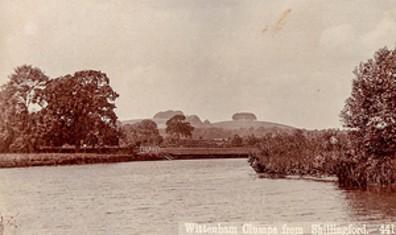
Wittenham Clumps from Shillingford
The romance of Shillingford barely lasted the war. A decade later, my parents were imprisoned in it because their London house had been let. It was wonderful in the summer, but in the winter, it was freezing cold, a cold cruelly enhanced by damp. The house had no central heating, and when the catacombs of the cellar filled with water as the river rose, as it so often did, the damp seeped through the house, defying all efforts to expect it. The fireplaces were useless, and experiments with oil heaters proved ineffective. On top of that, fuel was rationed. My mother, huddled in an American bomber jacket, would stand shivering in the study, the smallest room in the house and the only one every properly defrosted. She would gaze at the beautiful view and she cried out, an edge of desperation in her voice, that when they bought Shillingford, they never imagined they would ever have to live in it.
Egg Production
Gina’s parents couldn’t imagine life without eggs and so during the war her father, Henry became obsessed with hens and egg production.
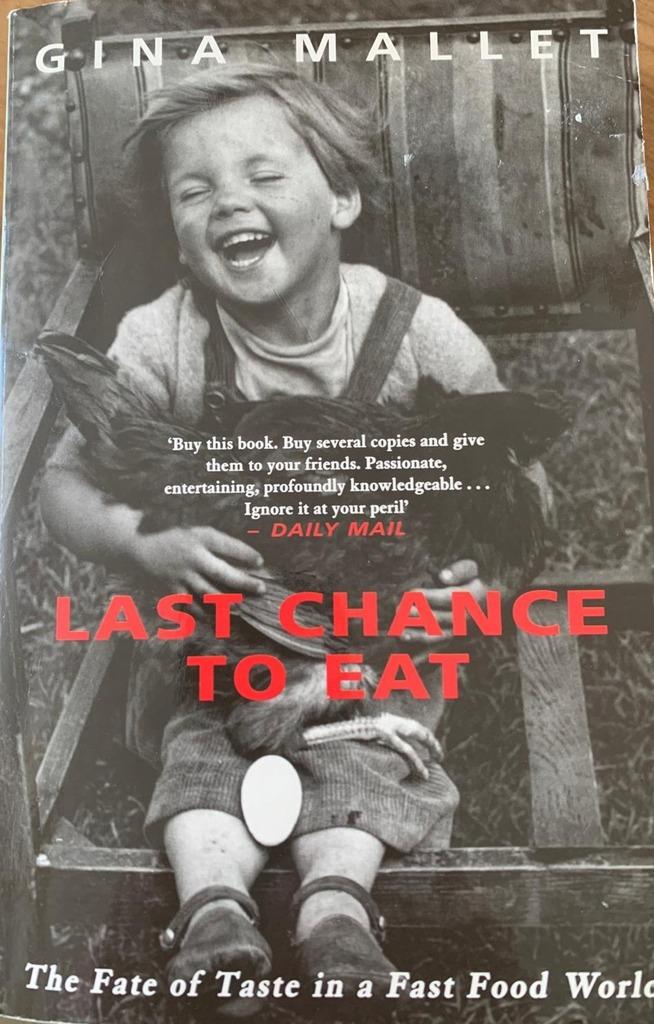
The cover of Gina’s book showing her holding one of the chickens
There were about a hundred hens in the old tennis courts where Ben, the part-time gardener, had put together some rudimentary henhouses protected by a fence of chicken wire. But the chickens had no trouble scratching aside or wiggling under the wire and strolling off where they pleased. Foxes had a field day. Wandering off to lay where they wanted presented a problem because keeping hens for food threw a spanner in the government’s stringent rationing rules and my parents would have to give half of their eggs to the government, which was a nuisance – and the egg commissar who supervised the accounting of eggs would become a considerable nuisance.
My father, having directed the egg programme, then took off for London, where he spent the week in his club, fed whisky by ancient servants, returning to the country only at weekends, which was when the commissar was off duty.
My mother came up with an egg hunt. The entire household was sent egg-hunting through the orchard and the paddocks, the gully and the copse, the long chestnut tree lined drive.
When they first bought Shillingford, people came to call, as was the country way. The very first neighbour was such a nice man, my mother remembered. He told her he had just come from beagling. My mother had no idea what he was talking about, but she wanted to be friendly, so she said, ‘Did you shoot any?’ He left shortly afterwards, went home and died immediately. Of shock, of course, said my father, and wasn’t it lucky he didn’t have time to tell anyone else because then nobody else would have dared to call.
The flavour of raw milk
As a child, I happily drank raw milk. For several years, it was considered the greatest of treats. In Shillingford, on Thursday afternoons, my sister and I used to stop at the farm on our way home from school. We would tap on the kitchen window, which was flung up by Cally, who was the farmer’s cousin. She would beckon us in to the sparkling tiled dairy, which smelled of washing. On a big wooden table lay large, shallow, stainless-steel pans of milk with cream rising slowly to the surface. The cream was the colour of daffodils. The cows were the super-rich Jerseys and Guernsey’s. Cally poured us a glass of fresh milk still warm from the cow, and it was so good. The milk smelled earthy and complex. Then Cally would hand us each a piece of fresh bread, spread with farm butter and homemade strawberry jam, and lay on it a layer of thick cream that spread like cheese. This was quite simply the best food we had all week.
The Natural Way
Our nanny inculcated us into the country ways of Shillingford. Time had paused in Shillingford, change so incremental as to be invisible. Nobody fussed over the disappearance of the wharf next to our house and the fact that the hamlet’s road now ran straight into the river. The fields were odd shaped, with names like Home Meadow and Three-Quarter Field. The cows ambled to the water meadows to drink and the river was thus undoubtedly polluted, but who knew or cared? We children still swam in it without getting ill.
The farm was the main employer. As my sister and I walked home from school, we would pass the farmworkers on their way home. They wore old clothes, the men’s corduroys patched and their shirts darned, but their boots were real leather and had thick leather soles, and they wore cloth caps to shade their faces from the sun. They smelled of the earth, a sweet smell of stored apples, and their hands were grooved with dirt. They spoke Oxfordshire, an accent with glottal stops, the skipping of a consonant here and there. In the spring, men would come to the riverbanks and cut the willows to make the whips into baskets, and more men would be slicing off hazel branches and splitting them to weave wattle fences.
The countryside was packed with wildlife. The hedgehog – Mrs Tiggywinkle, of course, was a friend. So were the two baby red squirrels we found abandoned; Nanny showed us how to feed them with fountain-pen fillers charged with milk. A marauding snake was killed by Nanny, armed with a big stick. Then, in front of us, she skinned it and set out to dry its handsome Paisley-patterned skin, which she later made into a belt for my sister.
When Nanny decreed that summer pudding should be made with wild blackberries and nothing else, we believed her. Some people said that summer pudding could be made with whatever berries were available but Nanny was quite firm about the superiority of the blackberry. The hedgerows where the blackberries flourished were the country people’s market garden. In the autumn, the hamlet children picked their way along the hedgerows that bordered the old rights of way cutting through our property, hurrying to beat the birds, as Nanny said. There were hips and haws, which made a good tea or jelly, and elderberries for elderberry wine. The blackberry produced a royal purple pudding. I think a summer pudding is as good as any fruit tart, mainly because it is fruitier.
Everyone in Shillingford had a garden of some kind; the villagers had allotments in the farmer’s fields, where they grew a variety of plants. Oxfordshire was farming country, grain and livestock.
In our village, vegetables were runners-up to flowers – with the exception of the vegetable marrow. Vegetable marrow is a summer squash that only the English seem to love, it is a watermelon-sized courgette. Villagers competed fiercely to grow the largest marrow and capture the prize at the local flower show. My mother had no patience for it. ‘No one can eat such a big marrow, she complained. ‘Why don’t they pick them when they’re small and then they’d be delicious
The Lost Kitchen Garden
Six years of war and an errant German bomb had pretty well finished off the kitchen garden at Shillingford. How desolate it looked. All that was left of the three greenhouses was broken glass and tangled wreckage in the forest of weeds, which had grown like a jungle, obliterating the order of what was once a proper Victorian kitchen garden. There had been no stinting in designing Shillingford Court’s kitchen garden, because a kitchen garden was a status symbol. It made the owner self-sustaining in food – and the food was something to show off.
The garden was a quarter-acre rectangle filled with beds of fruit and vegetables. There must have been rows of peas and green beans. Brussels sprouts, kale and cabbage, potatoes, beets, carrots, raspberry canes, lots of gooseberries, red, black and white currants, rhubarb and strawberries – many kinds, of course – all bordered by walls and trees. Cardoons, the thistly artichoke so liked by the Victorians and scorzonera too, a black salsify. The greenhouses housed tomatoes and cucumbers, melons and grapes, figs, nectarine and peach trees.
Nanny looked over the remains of vegetable garden with sorrow. A gardener herself, she itched to get her hands in the soil. She could remember what the garden had looked like, the raised beds of strawberries and beans, the raspberry canes, the fragrance of the flowers that bordered the beds and the drowsy sound of bees as they pollinated the plants.
She could remember the gardener, too. His name was Ted and he lived in the bungalow – a grim one-storey building that squatted between the kitchen garden and the riverbank – picking up local help as he needed it.
All self-respecting English country houses had an orchard and Shillingford Court was no exception. The orchard at the end of the driveway of chestnut trees bloomed scores of pink and white candles in the spring. From 1939 to 1946, the orchard went to seed, and the only apples we children found were small, green and hard. When we bit into them, they tasted bitter so we fed them to the ponies or let our neighbour, David, use them as targets for his airgun.
Good day for killing pigs
Old Ben, the pensioner who did odd jobs around the garden in Shillingford, came into the kitchen, his breath blowing smoke. ‘There’s a hoar frost today’ he said, as he put his chapped red hands round a mug of tea, our kitchen always being good for tea, perhaps elevenses, and even a soup lunch if he timed it right. ‘Good day for killing the pigs.’ Of course, this was the day our pig was going to be killed. Our pig had been bought by my parents as part of their home-grown food programme, at the urging of Dick, the farmer**. Dick assured them this was going to be much easier than the chickens. The pig could be kept at the farm and we’d never have to see it if we didn’t want to. It would be fed with the farm pigs and slaughtered at the same time, and we would then have half of it as our own. The government, he sighed, would take the other half. Our bacon ration would be cancelled for a year. Even so, there would be ham, and roasts, tenderloin, chops, our own bacon, plenty of wonderful pork fat and trotters – pigs’ feet – if anyone knew what to do with them anymore.
The Mallet family left Shillingford in the 1950s and returned to London.
*Mr Haggie was not the tailor who had built Shillingford Court that was Mr Frederick Mortimer. The Haggie family arrived at Shillingford Court in 1914.
** This would have been John Richard Warburton.
Penguin Random House Canada in 2026 advised us that any rights McClelland & Stewart held for the title Last Chance to Eat by Gina Mallet reverted to the author in April 2010. As Gina Mallet passed away in 2013, the rights remain with her estate which we acknowledge.
Extracted from the book by Lynda Raynor