Joseph Tubb was baptised in St Laurence Church on June 16th, 1805, the son of Benjamin & Martha Tubb.
Joseph lived in what is now Lavender Cottage on the Green North.
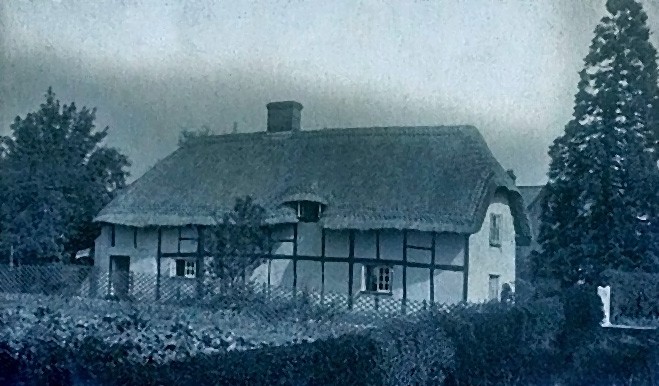
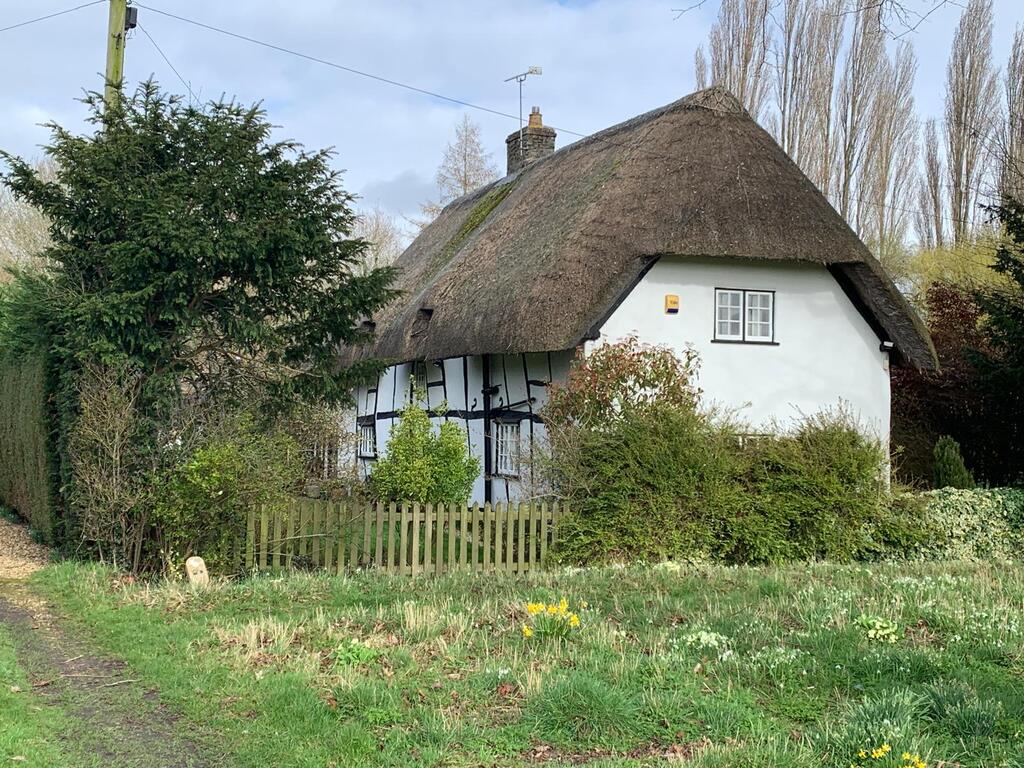
Joseph wanted to become a wood carver but his father encouraged him to follow in the family footsteps and he became a Maltster.
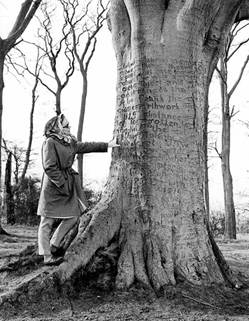
Joseph is remembered locally for The Poem Tree which once stood on Castle Hill at Wittenham Clumps. One summer in the mid 1840’s he camped on the hill and carved the 20-line poem in a large beech tree on the eastern side of the hill.
The slight difference between the written original and that carved in the tree is attributed to him carving from memory.
As up the hill with labr’ing steps we tread,
Where the twin clumps their sheltering branches spread,
The summit gain’d, at ease reclining lay,
And all around the widespread scene survey
Point out each object, and instructive tell
The various changes that the land befell –
Where the low banks the country wide surround –
The ancient earthwork formed old Mercia’s bound.
In misty distance see the furrow head –
There lies forgotten lonely Gwichelm’s grave.
Around the hill the ruthless Danes entrenched
And the fair plains with gory slaughter drench.
White at our feet where stands that stately tower
In days gone by up rose the Roman power.
And yonder there, where Thames’ smooth waters glide,
In later days appeared monastic pride.
Within that field where lies the grazing herd
High walls were crumbled, stone coffins disinter’d.
Such, in the course of time, the wreck which fate
And awful doom award the earthly great.
Joseph remained a bachelor and had a passion for country life.
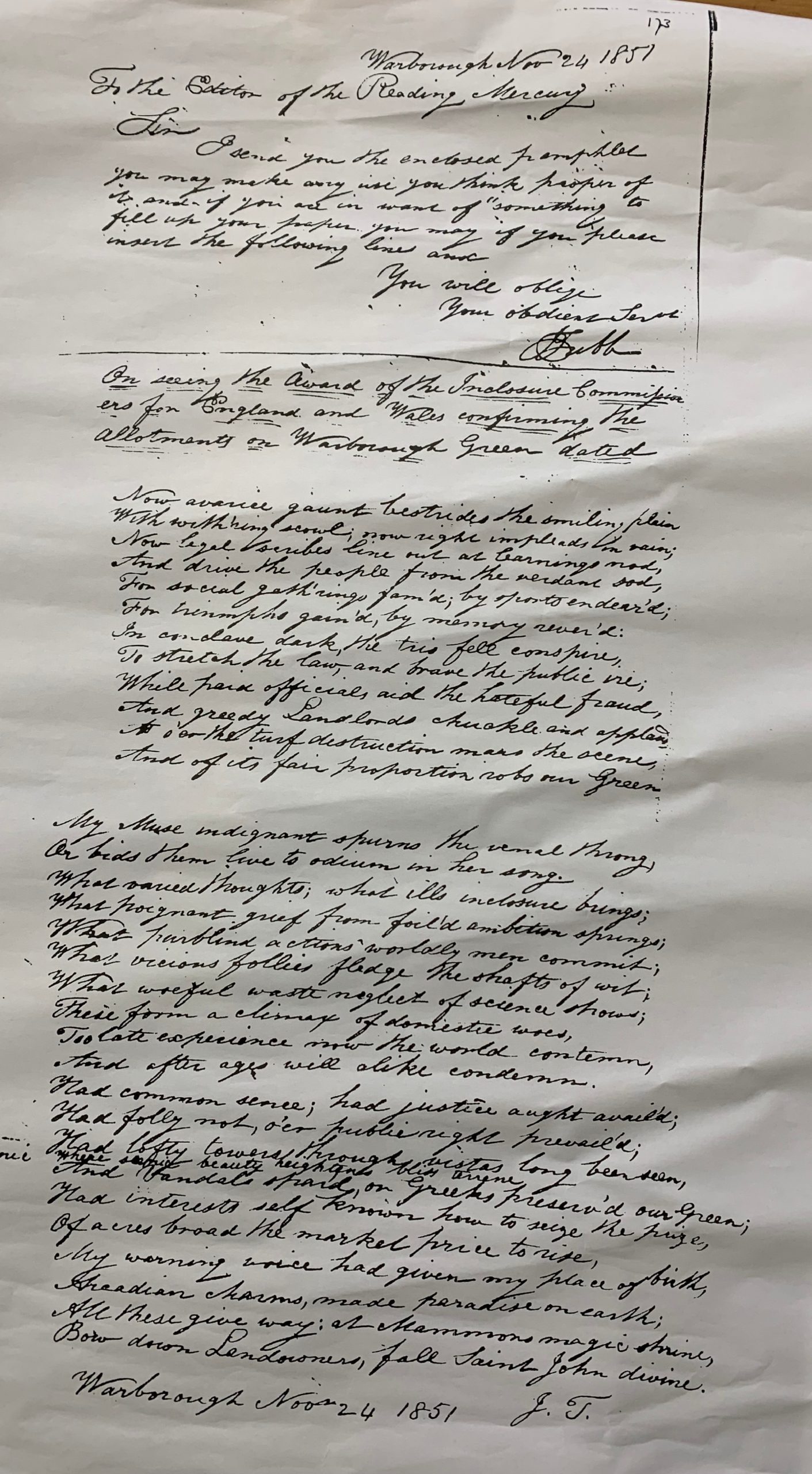
Actively opposing the enclosure of the commons, he pulled down fences, resulting in a short time in Oxford gaol.
On seeing the award by the Inclosure Commissioners for England and Wales confirming the Allotments on Warborough he wrote to the Reading Mercury, in poem form on 24th November 1851
‘Now avarice gaunt bestrides the smiling plain
With withering scowl; now right impleads in vain;
Now legal scribes line out at learnings nod
And drive the people from the verdant sod,
For social gath’ring famed; by sports endear’d;
For triumphs gain’d, by memory rever’d:
In enclave dark, the trio fell conspire,
To stretch law, and brave the public ire;
While paid officials aid the hateful fraud,
And greed landlords chuckle and applaud
As o’er the turf destruction mars the scene,
And of its fair proportion robs our Green.
My muse indignant spurns the venal throng,
Or bids them live to odium in her song.
What varied thought; what ills inclosure brings;
What poignant grief from foil’d ambition springs;
What purblind actions worldly men commit;
What vicious follies fledge the shafts of wit;
What woeful waste neglect of science shows;
These form a climax of domestic woes,
Too late experience now the world contemn
And after ages will alike condemn.
Had common sense; had justice avail’d;
Had folly not, o’er public right prevail’d;
Had lofty towers through vistas long been seen,
Where scenic beauty heightens bliss serene,
And Vandals (?), or Greeks preserv’d our Green;
Had interests self known how to seize the prize,
Of acres broad the market price to rise,
My warning voice has given my place of birth,
Arcadian charms, made paradise on earth;
All these give way: at Mammons magic shrine,
Bow down Landowners, fall Saint John divine.
Joseph died in 1879 and is buried in the churchyard at St Laurence Warborough.
Sadly, the tree died in the 1990s but was safely left for visitors and as a habitat for wildlife. Unfortunately, once the base completely rotted, fluctuating weather conditions proved too much for the ancient trunk and finally toppled in 2012 bywhich time the poem had become difficult to read; the few legible letters having been distorted with growth of the tree.
In 1965, geographer Henry Osmaston took a rubbing of the poem before it became largely illegible. In 1994 this rubbing was used to create a plaque to commemorate 150 years since the carving. The plaque is fixed to a large Sarsen stone.
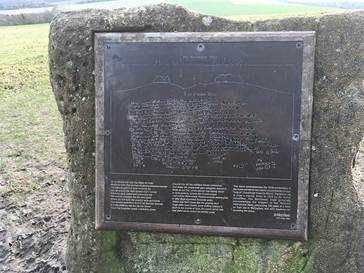
The famous Poem Tree now lies in pieces as nature intended, the deadwood providing valuable habitat and nutrients to the surrounding area.
Compiled by Lynda Raynor