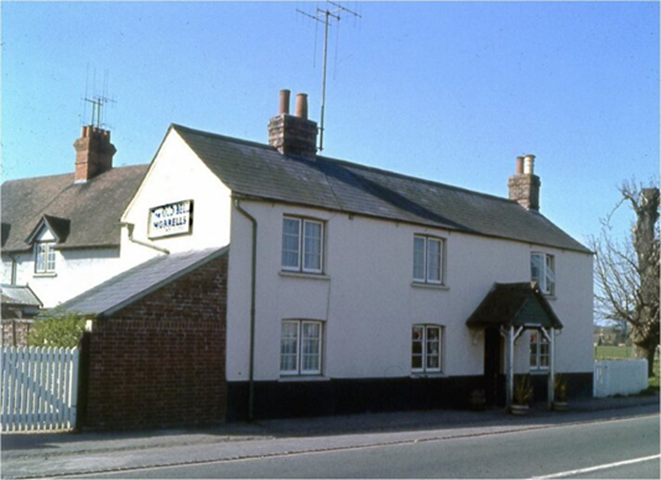
1972 just before its closure
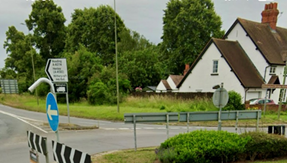
Location: What is now the Shillingford Roundabout – demolished.
The Old Bell Inn, originally known simply as the Bell, was built during the first half of the eighteenth century. Constructed of brick with a tiled roof, its principal entrance faced the Oxford Road (now Henley Road). Positioned on the Oxford–Henley coaching route, it would have been a regular stopping place for stagecoaches and travellers.
The inn’s strategic importance increased following the rebuilding and strengthening of Shillingford Bridge in 1764, which opened a new route to Reading via Wallingford. This development brought additional trade to the Old Bell, which stood at the junction of the Oxford Road and Wallingford Road. Further improvements followed in 1826, when New Road was constructed to allow better access for coaches and wagons using Wallingford Bridge. New Road branched from the Thame Road at Wheeler’s End and emerged at the Old Bell, forming a crossroads and improving the trade route from Thame and Aylesbury through to Reading.
The earliest known tenant of the Old Bell was Richard Boycott, who ran the inn from 1753 to 1760. He was succeeded by Henry Hill, who held the tenancy for an exceptional fifty-five years. Hill’s will, dated 27 May 1817, provided that his wife, Mary Hill: ‘shall receive an income from an investment of £200, stated at 5% per annum, until her demise and then the £200 to be shared equally between the surviving children’.
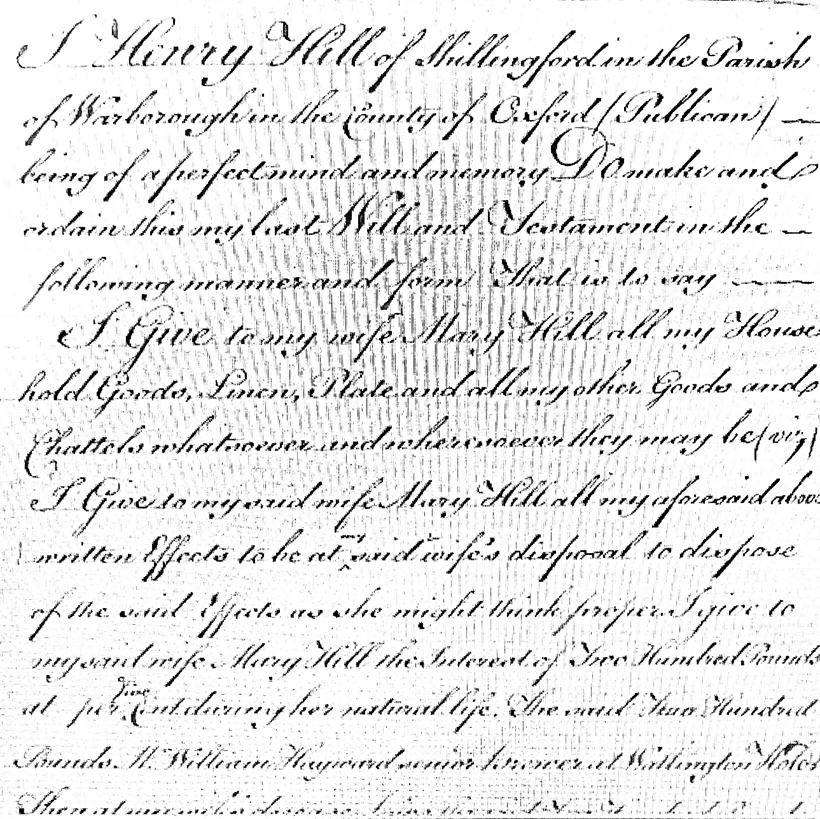
Last Will & Testament for Henry Hill, 27th May 1817 leaving his effects to Mary Hill
By the mid-nineteenth century, the Old Bell remained an active and sometimes controversial establishment. James Randell, who was publican between 1850 and 1851, was prosecuted for selling alcohol outside permitted hours and fined. He is not recorded as a publican the following year.
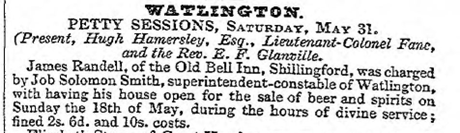
7 June 1851 Oxford Journal
In 1852, William and Eliza Townsend took over the tenancy. During their time at the Old Bell, one of the most notorious incidents in its history occurred. On the evening of 17 December 1869, Richard Green had been drinking at the inn before leaving in his horse-drawn cart. He was later found brutally murdered, his horse having made its way home some seven miles, where the body was discovered. The case attracted widespread attention, being reported not only in local newspapers but across Britain, including in Wales, Scotland, and Ireland. At the inquest, Eliza Townsend was the first witness to give evidence.
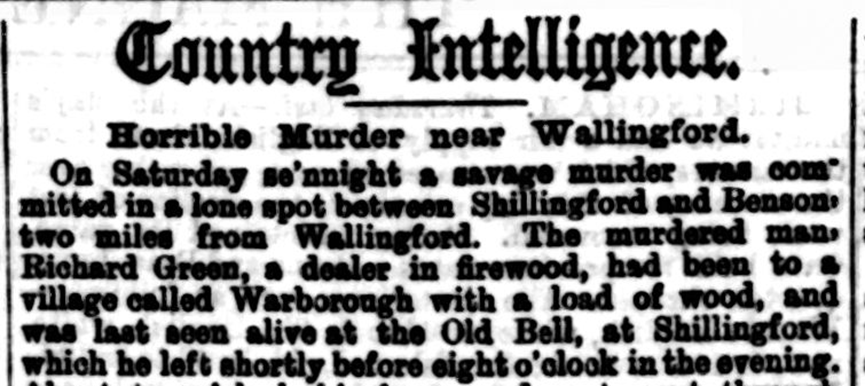
20th December 1869, The Magnet (London)
Following the death of William Townsend in 1877, Eliza ran the Old Bell on her own. She married Jacob Matthews in 1882 and died in 1885:

Oxfordshire Weekly News, 9th September 1885
An earlier violent incident had also been reported in 1875, involving a gunner of the Royal Artillery, further contributing to the Old Bell’s reputation as a lively and occasionally troubled coaching inn:
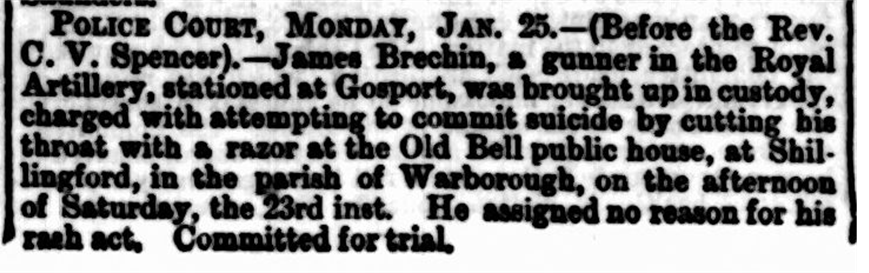
30th Jan 1875 Oxford Chronicle
Following the death of William Townsend in 1877, Eliza continued to run the Old Bell alone. She remarried in 1882, to Jacob Matthews, and died in 1885. Jacob Matthews carried on the business for a further year:

9th September 1885, Oxfordshire Weekly News
In 1886, the tenancy passed to John Tinson, initially as a holdover tenant*. He remained in occupation following the sale of the Old Bell in 1890
*A holdover tenant is a renter who remains in a rental property after their lease expires

13th November 1886, Berks & Oxon Advertiser
He remained the tenant publican after the sale of the Old Bell in 1890:
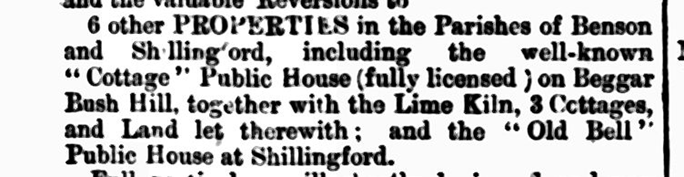
21 March 1890, Berks & Oxon Advertiser
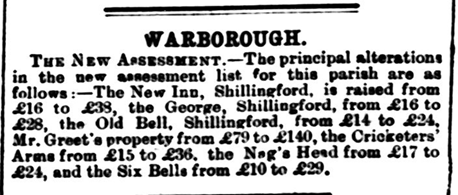
New Rate Assessments in 1903 show all the Warborough Parish increases, including the Old Bell:
Later tenants included David Lewis, followed by his widow Harriett Lewis, and subsequently Albert Arthur Cobb, who became licensee in 1909. Cobb and his family maintained a long association with the inn; his son Arthur Cobb took over the tenancy in 1949, remaining until 1958. Together, father and son were connected with the Old Bell for almost fifty years.
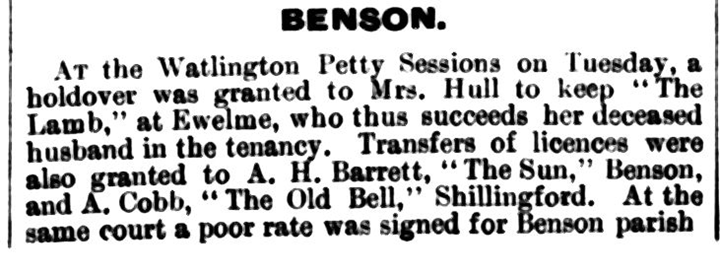
21st May 1909, Arthur Cobb gains licence
The Old Bell continued trading into the late twentieth century but finally ceased operating as a public house in 1969. The building stood for a few more years before being demolished in 1974, to make way for the Shillingford Roundabout. Today, nothing of the inn survives above ground, but its former position remains central to the village’s transport history.
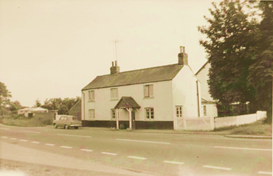
Old Bell Inn, c1960
Old Bell Inn stood on the far side of the present-day roundabout
Publicans & Tenants:
Richard Boycott 1753-1760
Henry Hill 1761-1816
Joseph Bond 1817-1819
Richard Archer 1820-1822
John Brooks 1847-1849
James Randell 1850-1851
William Townsend 1852-1877
Eliza Townsend 1887-1881
(m. Jacob Matthews)
Jacob & Eliza Matthews 1882-1885
Jacob Matthews 1885-1886
John Tinson 1886-1893
David Lewis 1894-1907
Mrs Harriett Lewis 1907-1908
H Lewis m. Arthur Cobb 1909-1948 (Assigns lease to son)
Arthur Cobb (son) 1949-1958
Mr & Mrs Harold Morris 1959-1969
Ceased Trading 1969
Old Bell demolished 1974
Researched by David Seymour, January 2026