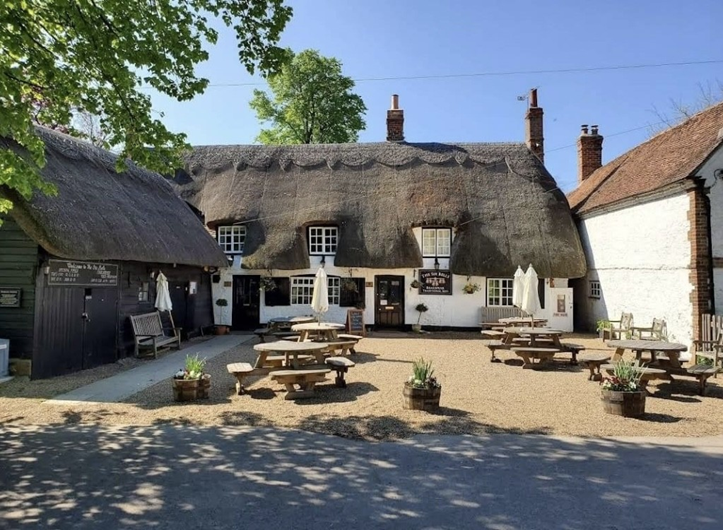
Six Bells in 2022
Location: 16, The Green South, Warborough
The Six Bells is the oldest surviving public house in Warborough and the wider Parish. Dendrochronological dating, carried out by the South Oxfordshire Project indicates that some of the principal ‘A’-frame timbers date from around 1465. The building was originally constructed as two cottages and was combined to form the building we see today.
The name, Six Bells, almost certainly predates the construction of St. Laurence’s Bell Tower of 1666, when two additional bells were installed, increasing the peal from 6 to 8. The inn therefore preserves an earlier reference to the church bells.
Architecturally, the Six Bells is typical of late medieval vernacular construction in the region. The main structure is built of clunch rubble with weatherboard timber framing and is served by three brick chimney stacks. The roof is thatched and incorporates three dormer windows that are ‘dovetailed’ into the thatch. The entrance door at the far-left is a relatively recent addition, dating from around 1950, replacing a small window visible on pre-war photographs. The original stables stand adjacent to the pub on the left and retain their timber-framed weather-boarded walls.
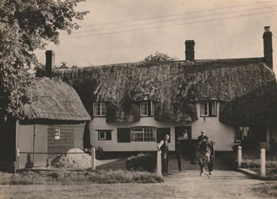
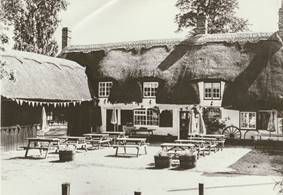
1928 photo showing window on left hand side. This is now the entry door into bar area added
Internally, the bar and kitchen occupy the left-hand side of the building, alongside a small dining area containing an original fireplace. A connecting passage leads to the principal dining room, while a rear garden opens directly from the bar area.
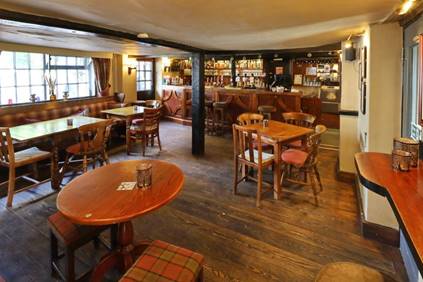
Bar and bar dining room
In 1776, John Shaw and Robert Appleton established a malt house at 86, New Street in Henley. Over the following years they acquired a portfolio of ten public houses, and by 1801, the Six Bells has been incorporated into their holdings following the death of John Shaw.
In the July of 1812, Robert Appleton paid £4,000 for Brakspear’s Stock and Trade including the Bell Street Brewery in Henley. For nearly two centuries the Six Bells has been owned and managed by Brakspear’s Brewery.
In 2006, Brakspear was sold to J T Davies for £106m, after which the Davies’s portfolio of fifty-one public houses was rebranded under the Brakspear name. Brakspear beer now brewed under licence by Marston’s Brewery, part of the Carlsberg Group
Henry and Ann Witney became tenants of the Six Bells in 1889. His unexpected death in 1906 was reported in the Berks & Oxford Advertiser, 11th May 1906:
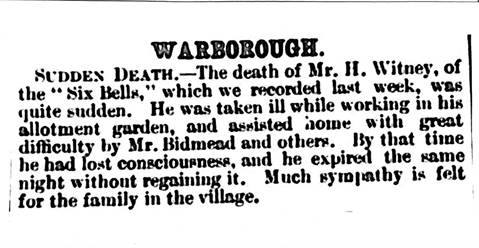
A few months later, their daughter Lizzie married Frederick Bitmead at St Laurence Church, Warborough. Frederick and Lizzie subsequently took on the tenancy of the Nag’s Head in Warborough in October 1910,
Also in 1910, David Tull applied for tenancy of Six Bells, taking over from Herbert Denman Hitch. Frederick Bitmead is recorded to have the tenancy of the Nag’s Head in the same report:
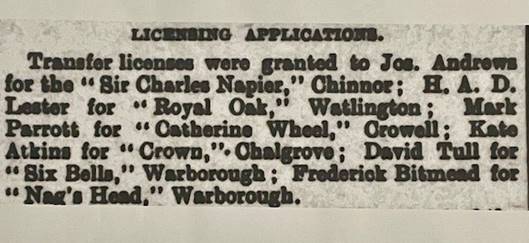
Oxford Times, 21st October 1910
The Six Bells was taken over in 1907 by Herbert Denman Hitch, who moved to Warborough from Aldershot. He married Elizabeth in 1901 after coming out of service in the Royal Engineers and serving briefly in South Africa during the Boer War (1899-1902). He signed up in 1894, aged 17, previously serving his apprenticeship in his father’s business as a coachbuilder. He left the Six Bells in 1910 and pursued his original career using his original skills, becoming the Estate Carpenter for Sir W, Nelson at Antwick’s Manor, Letcombe Regis before finally emigrating to South Australia.
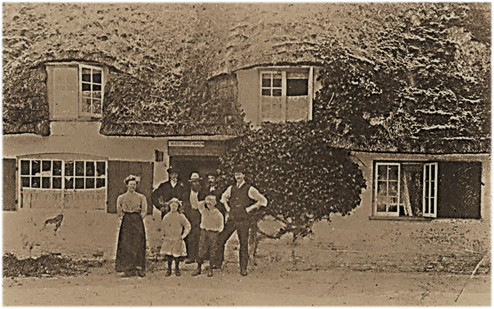
Herbert Hitch with his wife, Elizabeth, daughter Kathleen and son, Jack, 1910
A notably brief tenancy followed under Richard Walters, who took over the Six Bells after David Tull in 1913 and died in January 1914. Aged forty-two. His father, William Walters, was born in Warborough and had previously run the Lion Inn (later called Red Lion) in Wallingford. Richard has worked for his father for several years before taking on the Six Bells with his wife, Elvina Amelia Pike. His probate notice reads:
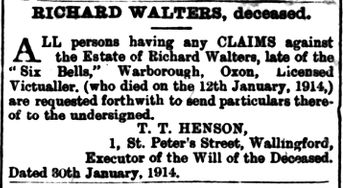
Berks & Oxon Advertiser, 30th January 1914
James Holliday, who was born in Dorchester in 1876, married Annie Cobb in 1902. He took over tenancy of the Six Bells in 1926, although he carried on part-time work as a cowman and later, as a labourer at a local sand extraction works.
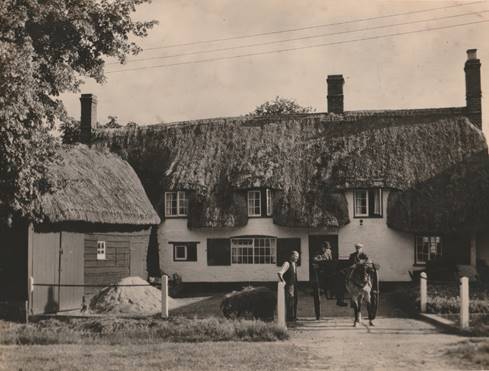
Publican James Holliday standing with George driving and Reg in the back c1928
They had 3 children, Roland, Valentine and Eunice and the two girls can be seen along the back wall during a fox hunt meet. He left the pub in 1948 and died 3 years later.
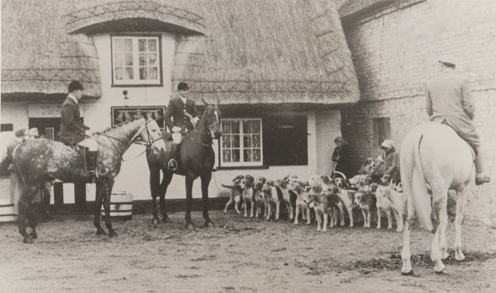
A Fox Hunt meeting at the Six Bells c1928. Valentine & Eunice Holliday, side of back wall c1928
In 1965, Arthur Valavanis and his wife Betty, were tenants of the Six Bell for 2 years. The photograph below shows him sitting in the cellar:
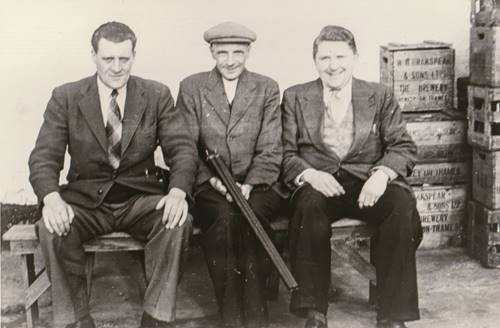
Harold Harrigan, Fred Tyler and Harold Valavanis c1965, Six Bells cellar
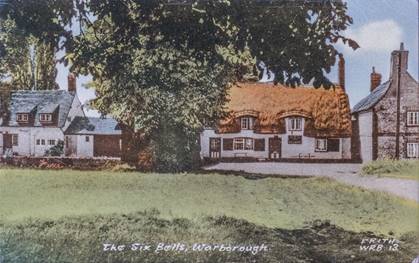
Six Bells, Postcard from 1957
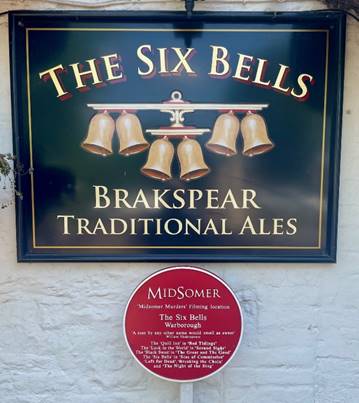
Red plaque outside of the Six Bells referencing Midsomer Murders
The Six Bells is probably many people’s idea of the quintessential English pub. Set alongside the village green and in the shadow of the church, it is unsurprising that Bentley Productions chose it to film some of their scenes for Midsomer Murders.
As taken from Midsomer Murders archive site:
The Six Bells is the jewel in the crown of Brakspear’s Midsomer Murder appearances. The picturesque, thatched pub is a Midsomer favourite, with the pub being featured 7 times throughout the series. First appearing in The Quill Inn in ‘Bad Tidings’ (2004), it has been a firm favourite in the show up to its most recent series 18. The Six Bells appears in ‘Sins of Commission’, ‘Left for Dead’, ‘The Night of the Stag’, and ‘Breaking the Chain’ and then as The Luck in the World in ‘Second Sight’, The Black Swan in the ‘Great and the Good’. When it’s not being featured in TV shows, the pub is a cosy and beloved local that is dog and family friendly.
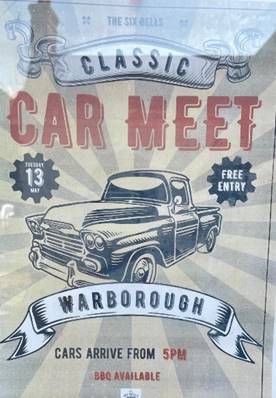
Advertising the monthly’ Car Meet’s
For more than five centuries, the Six Bells has occupied a central place in the life of Warborough and Shillingford, serving as a place of hospitality, community and continuity. Today, it remains the Parish’s last surviving public house and a tangible link to its medieval origins.
Publicans & Tenants:
Edward Moulder 1753 – 1768
Elizabeth Moulder 1768 – 1768
William Bannister 1769 – 1777
John Binham 1778 – 1785
William Bannister 1786 – 1808
Ann Rogers 1809 – 1811
Samuel Snell 1812 – 1822
John Greenaway 1847 – 1854
Vincent Cross 1861 – 1888
Henry & Ann Witney 1889 – 1906
Herbert Denman Hitch 1907 – 1910
David Tull 1910 – 1912
Richard Walters 1913 – 1914
William Shewry 1922 – 1925
James & Annie Holliday 1926 – 1948
Frederick Charles Eldridge 1948 – 1952
Donald Kempton Bartlett 1958 – 1962
Arthur James Alabaster 1963 – 1964
Arthur & Betty Valavanis 1965 – 1966
Roy J Tyghe 1967 – 1970c
Maurice & Sylvia Williams 1970c – 1978
John & Sarah Medlock 1979 – 1984
David & Yvonne Medway 1985 – 1986
Stephen & Deb Hakesley 1987 – 1990
Jim & Rosemary Bridge 1991 – 1992
Colin Davey 1993 – 1994
Ian & Christine Sanders 1995 – 1996
Ben & Libby Salter 1997 – 2010
Matthew & Paula Cockman 2011 – 2012
Fiona & Lesley Scott 2012 – 2014
Nicola (Nikky) Hickey 2014 – 2022
Gary & Sam Huntley 2022 – 2024
Eve Griffin & Henry Clayton 2024 –2026
Researched by David Seymour, January 2026