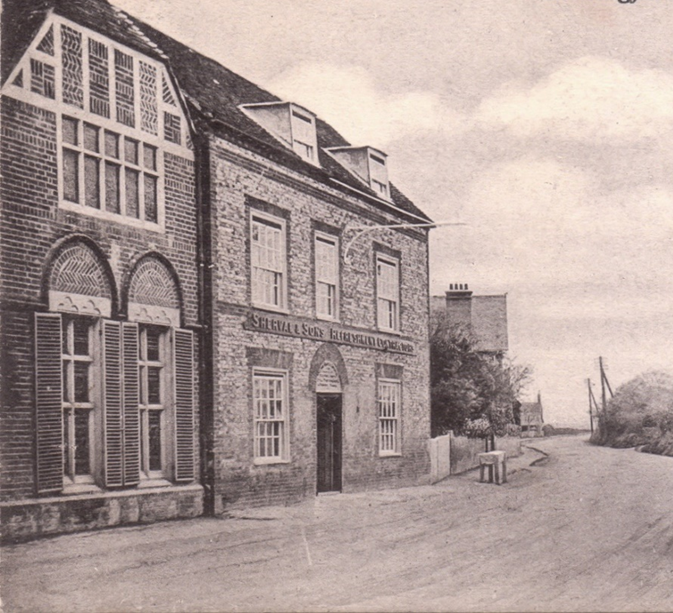
Location: To the left of 28, Henley Road, Shillingford
Very little now remains of The George. The building was largely demolished during the twentieth century, leaving only a fragment of the original front wall, reduced to the level of the lower sills of the ground-floor windows. The position of the original entrance can still be identified at the centre of this wall, where the doorway has been infilled with brick, almost certainly salvaged from the demolition. The opening retains its original width, marked by two vertical mortar lines. The remains of the George lie almost directly opposite the Kingfisher Inn, formerly the New Inn.
The George was originally signed The Sun, and was run by John Gleed from at least 1736 until 1746 according to Victuallers’ Licences. James Lambeth was the publican and owner until 1759, and it is during this period that it was renamed The George.
In 1747, William Crowley, owner of the adjoining Shillingford Brewery, constructed a wall on or adjacent to neighbouring land and entered into a formal deed with James Lambeth and Anthony Clackson. Under this agreement, Crowley assumed responsibility for maintaining the wall, while the ground upon which it stood became his property.
Ownership of the George later passed to Thomas Read, a yeoman of Warborough, who leased the inn on an annual basis. A surviving lease dated 11th November 1760 assigns the tenancy to Stephen Lambeth and describes the premises as: “the east part of the tenement heretofore called The Sun’ and now called ‘The George’, containing a parlour, a kitchen and a pantry or buttery and chambers over the same, together with a barn called the Wheat Barn and nearby stable”.
The property subsequently descended through Read’s family, passing first to his son and then to his granddaughter. In 1838, she sold The George to Martha Saunders, widow of Thomas Saunders II. Four years later, in 1842, Martha sold the inn to her brother, John Ashby, thereby combining ownership of the George with the adjacent Brewery.
Upon Ashby’s death in 1844, The George, Brewery, and Malthouse were willed to his nephew, Robert Saunders, who sold the combined estate in 1851 to Messrs Payne & Field, a well-established Wallingford firm that later became Field & Hawkins, with premises in the Market Square.
In 1889, Morland & Co. Ltd. acquired both The George and the Brewery. Their ownership continued until the house ceased trading and was demolished.
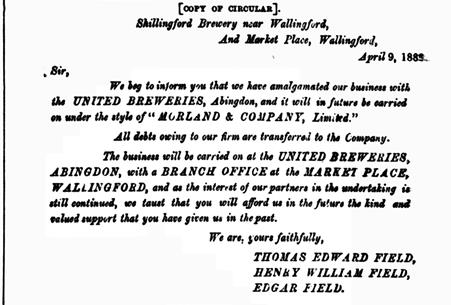
Notice of Intent dated 9th April 1889
At the time of Morlands’s acquisition, Edwin Pentycross was the resident publican. He is mentioned in the Berks & Oxon Advertiser, dated 14th June 1889: OXFORDSHIRE COUNTY PRIZE MEETING – At the recent prize meeting of the Oxfordshire Volunteers, the champion shot last year (Private Edwin Pentycross) was again the highest score, and the winner of the best prizes (in all £17).
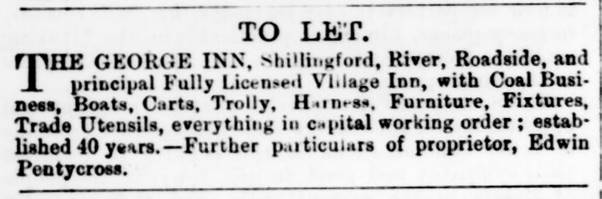
January 21st, 1892 – Banbury Guardian
Edwin Pentycross relinquished his licence in 1892.
Later that year, a tragic incident occurred following a supper held to welcome the new tenant, James William Bath. While returning home, Mr and Mrs Clutterbuck fell into the Thames; both were drowned, an event widely reported in the Oxford Times and other publications.
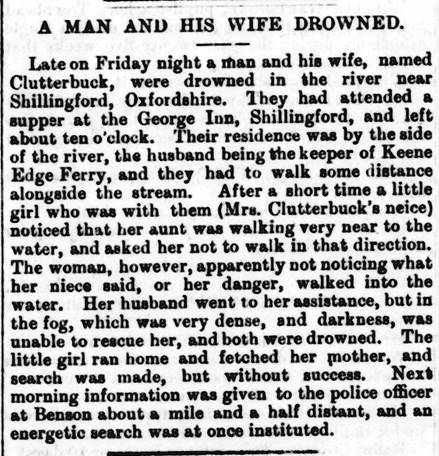
Oxford Times, 30th March 1892
In 1904, William Francis Sherval took over the tenancy. A well-regarded caterer from Reading, Sherval maintained both businesses during his tenure. In its final years, the George became known as a riverside stopping place, serving teas and refreshments to passing travellers.
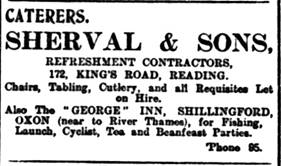
Reading Standard, 8th September 1906
Quoting from the Henley & Oxford Standard, 5th February 1909, it reports that: “William Frances Sherval, of The George Inn, Shillingford, was summoned for permitting drunkenness on his licenced premises on January 25th. A dinner of the Warborough Rifle Club was held in the Club Room. After the Dinner a smoking concert was held. Maurice Vaughan was deemed to be intoxicated on the premises and the: Bench were of the opinion that more care should have been exercised by the landlord and he (Sherval) would be fined £1 and costs of 16s, but the Bench did not wish the Brewery who owned the house to proceed any further in the matter”.
Sherval died later that year, and the following obituary was carried in the Reading Chronicle:
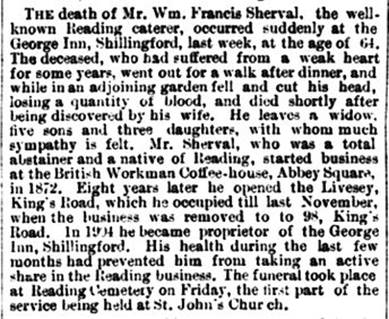
The George finally ceased trading in 1922, under the brief tenancy of Charles Oliver Swell, who successfully transferred the licence to the Cricketer’s Arms in Warborough. The decision, confirmed by the Licensing Committee in January 1923, was intended to provide a fully licensed house in Warborough while closing one in Shillingford, where another licensed premises already existed.
Although largely lost, The George remains an important part of Shillingford’s social and commercial history. The surviving wall and bricked-in doorway serve as a modest but tangible reminder of a once-prominent riverside inn.
Oxford Chronicle & Reading Gazette, 5th January 1923
The Licensing Committee reported:
The George Inn, Shillingford. The removal of the publican’s license from this house situated on the main road at Shillingford to the Cricketer’s Arms beer house, situated in the village of Warborough was confirmed. The effect of the confirming order was to satisfy the demand for a fully licensed house at Warborough, and to close a house at Shillingford where there is another fully licensed house.
The photo below shows (probably) William Sherval standing outside the entrance into the George. This aspect of the George was demolished shortly after 1925. The doorway is visible from the road today.
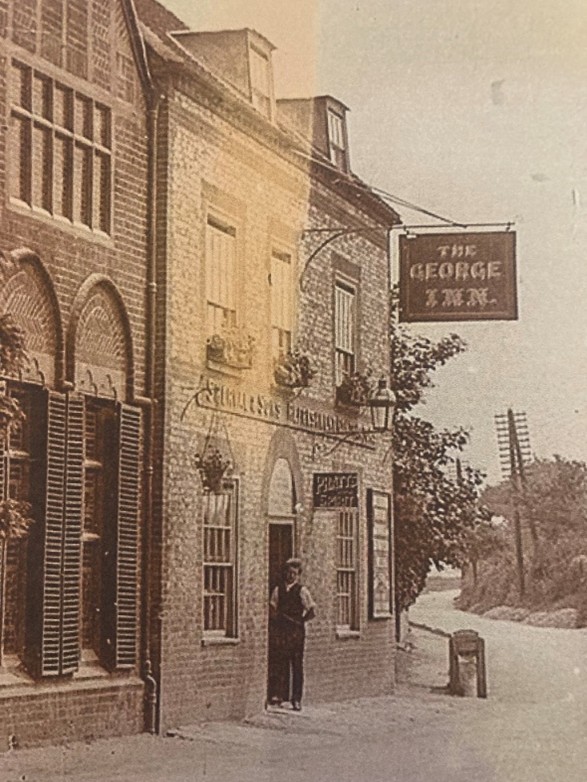
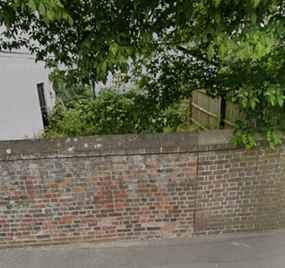
1911, original doorway., RH photo shows the bricked in doorway today
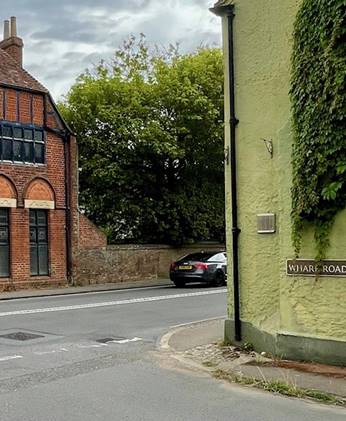
View from Wharf Road/ Kingfisher showing position of The George
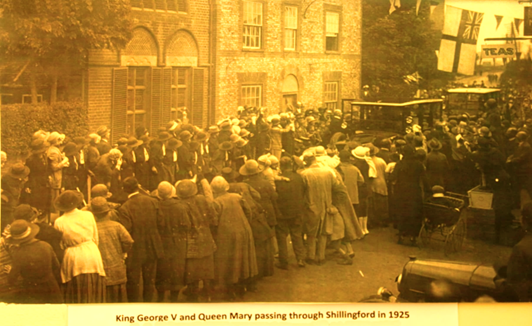
Passing through Shillingford, King George V and Queen Mary – 1925
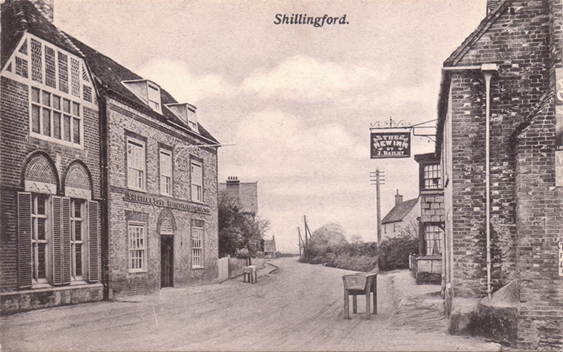
Location showing George relative to New Inn – 1916
Publicans & Tenants:
John Gleed – (The Sun) 1736-1746
Jonathan Brown 1747-1753
James Lambeth 1754-1759
Stephen Lambeth 1760-1771
Richard Willsdon 1772-1781
George Barnard 1782-1786
Samuel Harwood 1786-1791
Joseph Rogers 1791-1808
Ann Eldridge 1809-1822
Martha Saunders 1838-1841
John Ashby 1842-1846
John & Priscilla Cole 1847-1854
John Whichelo 1863-1869
William Henry Davis 1870-1873
Henry Davis 1874-1886
Edwin Pentycross 1887-1892
James William Bath 1892-1892
William Cross 1892-1893
G A Mattick 1893-1894
William Cooper 1897-1898
William & Harriett Culver1899-1901
George Moore 1902-1904
William Francis Sherval 1904-1909
Laura Sherval 1909-1911
Robert Goddard 1912-1920
Charles O Swell 1921-1922
Ceased Trading 1922
Researched by David Seymour, January 2026