1865 – 1939
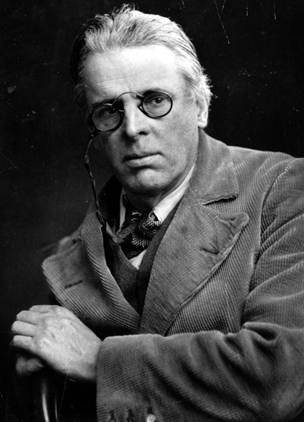
William Butler Yeats was born on June 13th 1865 at Sandymount, Dublin and is widely considered to be one of the greatest poets of the 20th century.
His father, John Butler Yeats, was a successful portrait artist who encouraged William’s artistic ambitions.
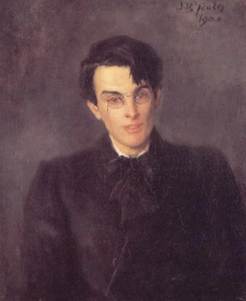
W B Yeats portrait by his father J B Yeats
He belonged to the Protestant, Anglo-Irish minority that had controlled the economic, political, social, and cultural life of Ireland since at least the end of the 17th century. Most members of this minority considered themselves English people who happened to have been born in Ireland, but Yeats staunchly affirmed his Irish nationality. Although he lived in London for 14 years of his childhood (and kept a permanent home there during the first half of his adult life), Yeats maintained his cultural roots, featuring Irish legends and heroes in many of his poems and plays.
In 1916 he became a staunch exponent of the nationalist cause, inspired by the Easter Rising, an unsuccessful, six-day armed rebellion of Irish republicans against the British in Dublin. Yeats reacted by writing “Easter 1916”, an eloquent expression of his complex feelings of shock, romantic admiration, and a more realistic appraisal.
In 1917 he married Bertha George Hyde-Lees and their daughter, Anne Butler Yeats, was born in Dublin in 1919.
Only four days after the wedding, his bride began what would be a lengthy experiment with the psychic phenomenon called automatic writing, in which her hand and pen presumably served as unconscious instruments for the spirit world to send information. Yeats and his wife held more than 400 sessions of automatic writing, producing nearly 4,000 pages that Yeats avidly and patiently studied and organized. From these sessions Yeats formulated theories about life and history.
In the early 1920’s, continued unrest in Ireland led the couple and their daughter Anne moving to 4 Broad Street, Oxford.
In February 1921 he was at the Oxford Union debating in favour of self-rule for Ireland.
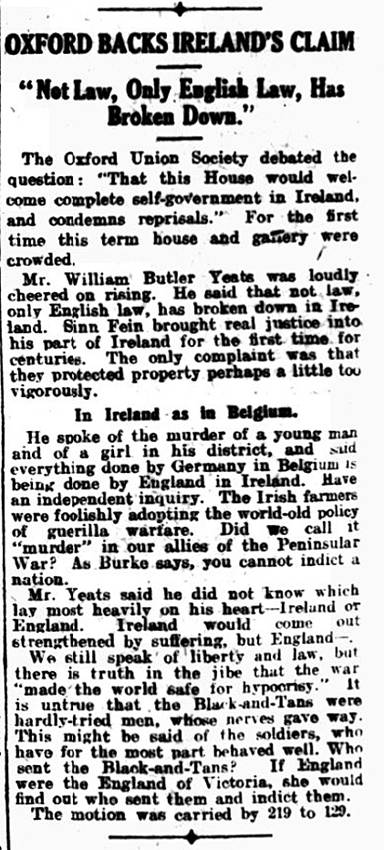
Catholic News 26th. February 1921
According to his biographer, R F Foster, his wife was restless in Oxford and felt that she couldn’t mix with the don’s wives: “even if she were in the way of meeting them I can think of very little in common between Mrs Yeats & the average don’s lady in North Oxford or on Boar’s Hill”.
In March 1921 they decided to economise by letting out 4 Broad Street “for a pot of money – £5 10/- per week” and moving to a rented cottage in Shillingford.
So, in April 1921, they moved to Wheeler’s End, at that time called Minchin’s Cottage, at the junction of Thame Road and Warborough Road.
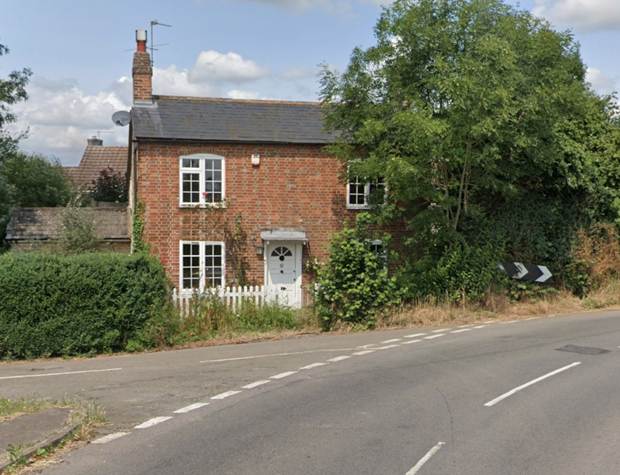
Wheeler’s End, previously Minchin’s Cottage, Shillingford
From there he sent a couple of letters to a close friend, Olivia Shakespear, incorrectly attributing Shillingford to Berkshire. He always called his wife George after her middle name.
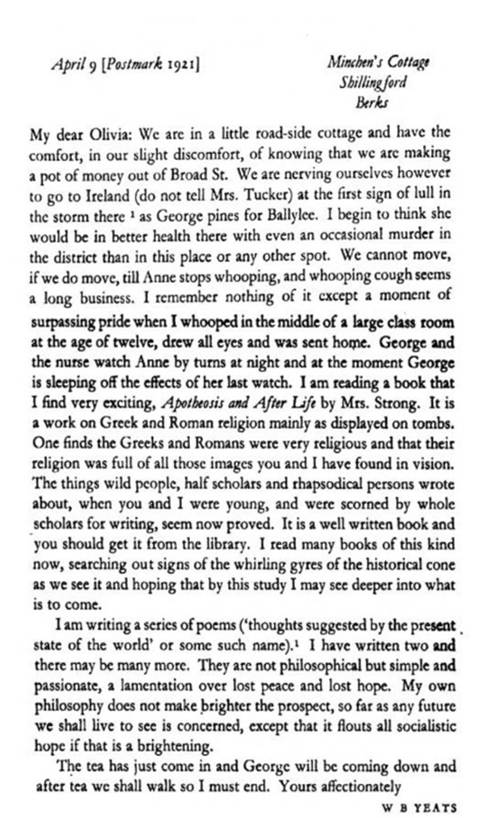
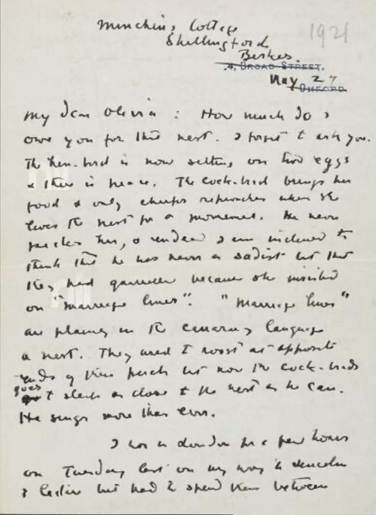
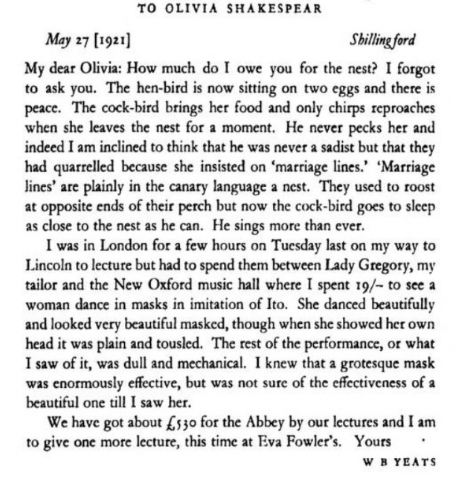
During their time at Wheeler’s End, the family found the large garden to be an ideal environment for Anne, who was able to play outdoors while she recovered from whooping cough. This provided a peaceful setting for her convalescence, away from the bustle of city life.
Meanwhile, Bertha aka George, now expecting their second child, was able to rest in the quiet rural surroundings. Despite these comforts, the countryside made her long for her native Ballylee, and she experienced a sense of homesickness for the familiar landscape of her childhood.
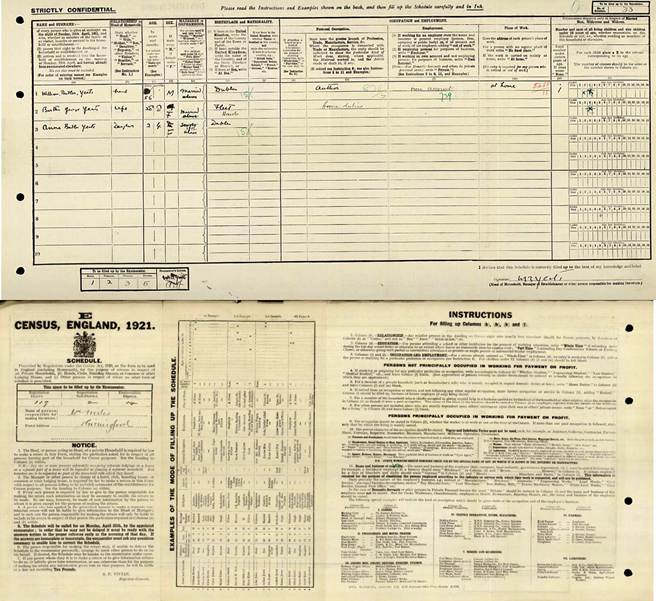
1921 Census
Shortly after the census was taken his wife gave birth to a son, William Michael Butler Yeats, the birth being registered at Thame in August 1921.
Some of Yeats’ best poetry was apparently written whilst he was in Shillingford.
In 1921 bitter controversies erupted within the new Irish Free State over the partition of Northern Ireland and over the wording of a formal oath of allegiance to the British Crown. These issues led to an Irish civil war, which lasted from June 1922 to May 1923. Yeats emphatically sided with the new Irish government.
He accepted a six-year appointment to the senate of the Irish Free State in December 1922, a time when rebels were kidnapping government figures and burning their homes. In Dublin, where Yeats had by then assumed permanent residence, the government even posted armed sentries at his door. As a senator, Yeats considered himself a representative of order amid the chaotic new nation’s slow progress toward stability.
In 1923 he was awarded the Nobel Prize for Literature.
Now a celebrated figure, he was indisputably one of the most significant modern poets. In 1936 his “Oxford Book of Modern Verse 1892-1935”, a collection of the poems he loved, was published.
Yeats died in January 1939 whilst abroad. Final arrangements for his burial in Ireland could not be made, so he was buried at Roquebrune, France. The intention of having his body buried in Sligo was thwarted with the outbreak of World War II in the summer of 1939. In 1948 his body was finally taken back to Sligo and buried in a little Protestant churchyard at Drumcliffe, as he specified in “Under Ben Bulben”, in his “Last Poems”, under his own epitaph:
Cast a cold eye
On life, on death.
Horseman, pass by!
Researched by Ray Thackrah
With thanks for additional information from Charlotte Ward Perkins